
Long ago ,there lived in Greece a learned man. He was so well known for his good knowledge of almost everything that lots of people from all over the country came to learn from him. The great man taught his students whole-heartedly and answered their questions with great patience.
One day a student asked him, “ My dear teacher, didn’t you say you yourself have many ,many more questions about things than we do? But I think we students have far more than you.”
With a smile on his face, the teacher drew two circles ,one as large as a big cake, the other smaller. Then he said , “Of course, I have learned much more. But it’s wrong to think that a teacher has fewer questions than his students. Now, look at these two circles. The inside of the bigger one is my knowledge of things, and the inside of the smaller one is yours. Out of the circles is what is still unknown to us. Since mine is larger, I have to use the longer line to draw the bigger circle. That means I have more opportunities to face what is still unknown. And that’s why I myself have more questions than you do. The more you learn , the more questions you have. You will never learn enough ,you know.”
1.The learned man drew two circles to show _____.
A. he was good at drawing circles
B. his knowledge had something to do with the circles
C. why he had more questions than the students
D. how he could get more knowledge
2.The student didn’t agree that ______.
A. the teacher had so many questions as a learned man
B. the teacher had so many questions
C. the students had fewer questions than the teacher
D. the students had more questions than 0the teacher
3.The teacher was famous for his ______.
A. kindness B. knowledge C. patience D. questions
4.From the passage we can learn that_____.
A. the more questions we have, the more knowledge we may get
B. it’s never too old to learn
C. every one of us should try to be a learned man
D. a teacher should have many questions
5.Which of the following shows us what the teacher drew?
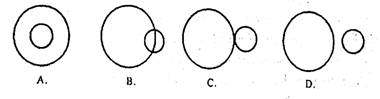
1.C
2.C
3.B
4.B
5.A
【解析】
1.理解歸納題,根據(jù)文中第三自然段的語句理解可知。
2.細節(jié)理解題,根據(jù)文中語句“didn’t you say you yourself have many ,many more questions about things than we do? But I think we students have far more than you.””理解可知。
3.細節(jié)理解題,根據(jù)文中語句“Long ago ,there lived in Greece a learned man. He was so well known for his good knowledge of almost everything that lots of people from all over the country came to learn from him.”理解可知。
4.理解歸納題,,根據(jù)文中語句理解可知。
5.細節(jié)理解題,根據(jù)文中語句“l(fā)ook at these two circles. The inside of the bigger one is my knowledge of things, and the inside of the smaller one is yours.”理解可知。

科目:初中英語 來源: 題型:閱讀理解
| A.the pea | B.the nut | C.both the pea and the nut | D.neither the pea nor the nut |
| A.Paragraph Four | B.Paragraph Three |
| C.Paragraph Two | D.Paragraph One |
| A.Helpful for staying healthy. | B.Helpful to the poor. |
| C.Delicious and tasty. | D.Rich in fat and oil. |
| A.Nomads always stayed in the same place. |
| B.The peanut was first found in South America. |
| C.Astronauts ate lots of peanuts to keep healthy. |
| D.China grows fewer peanuts than the US. |
| A.To show that peanuts belong to the pea family. |
| B.To advise us to use more peanut products. |
| C.To tell us some new uses of peanuts. |
| D.To let us know more about peanuts. |
查看答案和解析>>
科目:初中英語 來源:2012屆北京市大興區(qū)初三上學期期末考試英語試卷(帶解析) 題型:閱讀理解

Around the world more and more people are taking part in dangerous sports and activities. Of course, there have always been people who have looked for adventure(冒險)---those who have climbed the highest mountains, traveled into unknown parts of the world or sailed in small boats across the greatest oceans. Now, however, there are people who look for an immediate excitement from a risky(冒險的) activity which may only last a few minutes or even seconds. I would consider bungee(蹦極) jumping to be a good example of such an activity. You jump from a high place(perhaps a bridge or a hot-air balloon) 200 meters above the ground with an elastic(有彈性的) rope tied to your ankles. You fall at up to 150 kilometers an hour until the rope stops you from hitting the ground. It is said that about 2 million people around world have now tried bungee jumping. Other activities which most people would say are as risky as bungee jumping include jumping from tall buildings and diving into the sea from the top of high cliff(懸崖).
For the reasons, some psychologists explain that many people think their life in modern societies has become safe and boring. Not very long ago, people’s lives were constantly(持續(xù)的) in danger. They had to go out and hunt for food, diseases could not easily be cured, and life was a continuous battle (戰(zhàn)爭)for survival.
Nowadays, according to many people, life offers little excitement. They live and work in comparatively safe conditions; they buy food in shops; and there are doctors and hospitals to look after them if they become ill. The answer for some of these people is to look for danger in activities such as bungee jumping.
【小題1】Are there many people who are taking part in the dangerous sports?
【小題2】How many kinds of dangerous sports does the writer refer to?
【小題3】How long does a bungee jumping usually last?
【小題4】What do many people think of their life nowadays?
【小題5】What does the writer tell us in the last two paragraphs?
查看答案和解析>>
科目:初中英語 來源:2015屆廣東省廣州市八年級上學期期末考試英語試卷(解析版) 題型:閱讀理解
No one knows how man learned to make words. Perhaps he began by making sounds like those made by animals. Perhaps he grunted like a pig when he lifted something heavy. Perhaps he made sounds like those he heard all round him—water splashing, bees humming, a stone falling to the ground. Somehow he learned to make words. As the centuries went by, he made more and more new words. This is what we mean by language.
People living in different countries made different kinds of words. Today there are about fifteen hundred different languages in the world. Each contains four or five hundred thousand words. But we do not need all these. Only a few thousand words are used in everyday life. The words you know are called your vocabulary. You should try to make your vocabulary larger. Read as many books as you can. There are plenty of books written in easy language. Your dictionary is your most useful book.
1. What do we mean by language?
A. Sounds made by man.???????
B. All the words made by man.
C. Different kinds of sound.?????
D. The way man learns.
2. Form the passage we know that long long ago________.
A. no one learned how to make sounds or words
B. animals taught man to learn the language
C. man learned the language by lifting heavy things, falling to the ground,and so on
D. man followed a lot of things in nature to make sounds and words
3. What is the number of languages spoken in the world today?
A. 500. ????????????? ????????????? B. 5,000.????????????? ????????????? C. 1,500.????????????? ????????????? D. 15,000.
4.In which sentence can the word "contain(s)" be put so that it is a right one?
A. I________ several dictionaries. ????????????? B. Sea water________ salt.
C. A dog _______ four legs.????? ????????????? D. Mr. Smith _____ glasses on his nose.
5. Which of the followings is the best if we want to make our vocabulary larger?
A. To read more books.????????????? ????????????? ???
B. To use the words in everyday life.
C. To use the words in class.????? ?????????????
D. To write the words.
查看答案和解析>>
科目:初中英語 來源:2014屆浙江杭州余杭區(qū)星橋中學初二下期期中考試英語卷(解析版) 題型:閱讀理解
Long long ago, a young man found a spring of delicious clean water while he was going through the desert. He brought some back to the oldest man in his village, who had been his teacher before. After a four-day journey he sent the water to the old man who took a deep drink, smiled warmly and thanked his student for the sweet water. The young man returned to his village happily. The next day, the teacher let another student taste the water. He spat it out, saying it was awful. It went bad because it had stayed in the old leather container(皮革容器) for so many days in such hot weather. The student asked his teacher why he pretended(假裝) to like the awful water. The teacher replied, "You only tasted the water. I tasted the gift. The water was simply the container for love and kindness. And nothing could be sweeter than these."
I think we understand this lesson best when we receive small gifts of love from very young kids. Whether it's a slice of bread or a piece of colored paper, the natural and right response(反應) is to show our thanks and happiness because we get love from the gift.
To show our thanks doesn't always come naturally. Unfortunately, most children and many adults only see the thing itself. They never feel the meaning of the thing. We should tell ourselves and teach our children about showing thanks and happiness to the persons who give the gifts from their hearts because gifts from the heart are really gifts of the heart.
1.Where did the young man find the water?
A.In a spring. B.In a river. C.In a lake. D.In a village.
2.How long did the water stay in the old leather container?
A.Six days. B.Five days. C.Four days. D.Three days.
3.What does the word “replied” mean?
A.smiled B.cried C.a(chǎn)nswered D.got angry
4.According to the passage, what is the right response when we get gifts from others?
A.We eat it up at once.
B.We only see the thing itself.
C.We think about the meaning of the bread.
D.We usually show our thanks and happiness naturally.
5.What does the writer want to tell us?
A.We should never receive anything from others.
B.We should show thanks and happiness when we get the gifts from the heart.
C.We should pretend to love the things given by others all the time.
D.We should give gifts from our hearts.
查看答案和解析>>
科目:初中英語 來源:2012年外研版初中英語九年級下Module 5 練習卷(解析版) 題型:單詞拼寫
綜合填空
根據(jù)短文和所給首字母寫出所缺單詞,使短文完整,意思通順、連貫
Do you know something about tree rings (年輪)? Do you know they can tell us what the weather was l__1___, sometimes even hundreds of years ago?
A tree will grow well in a climate with lots of sunshine and rainfall. And l__2__ sunshine or rainfall will limit (限制) the growth of a tree. We can see the change of climate by studying the tree rings. For e___3___, to find out the weather of ten years ago, count the rings of a tree from o___4___ to the inside. If the t___5___ ring is far from the eleventh ring, then we are sure that it was sunny and rainy most of that year. If it is near to the eleventh ring, then the climate that year was bad.
Tree rings are i___6___ not only for studying the history of weather but also for studying the history of man. Long long ago there lived a lot of people at a place in New Mexico. But now you can find only s___7___ there—no trees and no people. What h____8___?
A scientist studied the rings of d___9__ trees there. He found that the people had to leave b__10___ they had cut down all trees to make fires and buildings. As all trees had gone, the people there had to move.
查看答案和解析>>
國際學校優(yōu)選 - 練習冊列表 - 試題列表
湖北省互聯(lián)網(wǎng)違法和不良信息舉報平臺 | 網(wǎng)上有害信息舉報專區(qū) | 電信詐騙舉報專區(qū) | 涉歷史虛無主義有害信息舉報專區(qū) | 涉企侵權舉報專區(qū)
違法和不良信息舉報電話:027-86699610 舉報郵箱:58377363@163.com