
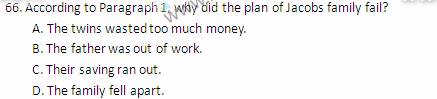
Diana Jacobs thought her family had a workable plan to pay for college for her 21-year-old twin sons: a combination of savings, income, scholarships, and a modest amount of borrowing. Then her husband lost his job, and the plan fell apart.
“I have two kids in college, and I want to say ‘come home,’ but at the same time I want to provide them with a good education,” says Jacobs.
The Jacobs family did work out a solution: They asked and received more aid form the schools, and each son increased his borrowing to the maximum amount through the federal loan (貸款) program. They will each graduate with $20,000 of debt, but at least they will be able to finish school.
With unemployment rising, financial aid administrators expect to hear more families like the Jacobs. More students are applying for aid, and more families expect to need student loans. College administrators are concerned that they will not have enough aid money to go around.
At the same time, tuition(學費)continues to rise. A report from the National Center for Public Policy and Higher Education found that college tuition and fees increased 439% from 1982 to 2007, while average family income rose just 147%. Student borrowing has more than doubled in the last decade,
“If we go on this way for another 25years, we won’t have an affordable system of higher education,” says Patrick M. Callan, president of the center. “The middle class families have been financing it through debt. They will send kids to college whatever it takes, even if that means a huge amount of debt.”
Financial aid administrators have been having a hard time as many companies decide that student loans are not profitable enough and have stopped making them. The good news, however, is that federal loans account for about three quarters of student borrowing, and the government says that money will flow uninterrupted.
【小題1】
According to Paragraph 1, why did the plan of Jacobs family fail?
| A.The twins wasted too much money. |
| B.The father was out of work. |
| C.Their saving ran out. |
| D.The family fell apart. |
| A.They asked their kids to come home. |
| B.They borrowed $20,000 from the school. |
| C.They encouraged their twin sons to do part-time jobs. |
| D.They got help from the school and the federal government. |
| A.more families will face the same problem as the Jacobses |
| B.the government will receive more letters of complaint |
| C.college tuition fees will double soon |
| D.America’s unemployment will fall |
| A.They blamed the government for the tuition increase. |
| B.Their income remained steady in the last decade. |
| C.They will try their best to send kids to college. |
| D.Their debts will be paid off within 25 years. |
| A.provide most students will scholarships |
| B.dismiss some financial aid administrators |
| C.stop the companies from making student loans |
| D.go on providing financial support for college students |
 習題精選系列答案
科目:高中英語 來源: 題型:閱讀理解
(2011·山東卷)C
Diana Jacobs thought her family had a workable plan to pay for college for her 21-year-old twin sons: a combination of savings, income, scholarships, and a modest amount of borrowing. Then her husband lost his job, and the plan fell apart.
“I have two kids in college, and I want to say ‘come home,’ but at the same time I want to provide them with a good education,” says Jacobs.
The Jacobs family did work out a solution: They asked and received more aid from the schools, and each son increased his borrowing to the maximum amount through the federal loan (貸款) program. They will each graduate with $20,000 of debt, but at least they will be able to finish school.
With unemployment rising, financial aid administrators expect to hear more families like the Jacobs. More students are applying for aid, and more families expect to need student loans. College administrators are concerned that they will not have enough aid money to go around.
At the same time, tuition(學費)continues to rise. A report from the National Center for Public Policy and Higher Education found that college tuition and fees increased 439% from 1982 to 2007, while average family income rose just 147%. Student borrowing has more than doubled in the last decade,
“If we go on this way for another 25years, we won’t have an affordable system of higher education,” says Patrick M. Callan, president of the center. “The middle class families have been financing it through debt. They will send kids to college whatever it takes, even if that means a huge amount of debt.”
Financial aid administrators have been having a hard time as many companies decide that student loans are not profitable enough and have stopped making them. The good news, however, is that federal loans account for about three quarters of student borrowing, and the government says that money will flow uninterrupted.
67. How did the Jacobs manage to solve their problem?
A. They asked their kids to come home.
B. They borrowed $20,000 from the school.
C. They encouraged their twin sons to do part-time jobs.
D. They got help from the school and the federal government.
68. Financial aid administrators believe that _______.
A. more families will face the same problem as the Jacobses
B. the government will receive more letters of complaint
C. college tuition fees will double soon
D. America’s unemployment will fall
69.What can we learn about the middle class families from the text?
A. They blamed the government for the tuition increase.
B. Their income remained steady in the last decade.
C. They will try their best to send kids to college.
D. Their debts will be paid off within 25 years.
70.According to the last paragraph, the government will .
A. provide most students will scholarships
B. dismiss some financial aid administrators
C. stop the companies from making student loans
D. go on providing financial support for college students
查看答案和解析>>
科目:高中英語 來源:2011—2012學年江蘇省南通中學高一第一學期期中考試英語試卷 題型:閱讀理解
Diana Jacobs thought her family had a workable plan to pay for college for her 21-year-old twin sons: a combination of savings, income, scholarships, and a modest amount of borrowing. Then her husband lost his job, and the plan fell apart.
“I have two kids in college, and I want to say ‘come home,’ but at the same time I want to provide them with a good education,” says Jacobs.
The Jacobs family did work out a solution: They asked and received more aid from the schools, and each son increased his borrowing to the maximum amount through the federal loan (貸款) program. They will each graduate with $20,000 of debt, but at least they will be able to finish school.
With unemployment rising, financial aid administrators(管理者) expect to hear more families like the Jacobs. More students are applying for aid, and more families expect to need student loans. College administrators are concerned that they will not have enough aid money to go around.
At the same time, tuition(學費)continues to rise. A report from the National Center for Public Policy and Higher Education found that college tuition and fees increased 439% from 1982 to 2007, while average family income rose just 147%. Student borrowing has more than doubled in the last decade,
“If we go on this way for another 25years, we won’t have an affordable system of higher education,” says Patrick M. Callan, president of the center. “The middle class families have been financing it through debt. They will send kids to college whatever it takes, even if that means a huge amount of debt.”
Financial aid administrators have been having a hard time as many companies decide that student loans are not profitable enough and have stopped making them. The good news, however, is that federal loans account for about three quarters of student borrowing, and the government says that money will flow uninterrupted.
【小題1】How did the Jacobs manage to solve their problem?
| A.They asked their kids to come home. |
| B.They borrowed $20,000 from the school. |
| C.They encouraged their twin sons to do part-time jobs. |
| D.They got help from the school and the federal government. |
| A.more families will face the same problem as the Jacobs |
| B.the government will receive more letters of complaint |
| C.college tuition fees will double soon |
| D.America’s unemployment will fall |
| A.They blamed the government for the tuition increase. |
| B.Their income remained steady in the last decade. |
| C.They will try their best to send kids to college. |
| D.Their debts will be paid off within 25 years. |
| A.provide most students will scholarships |
| B.dismiss some financial aid administrators |
| C.stop the companies from making student loans |
| D.go on providing financial support for college students |
查看答案和解析>>
科目:高中英語 來源:2012屆江西省泰和中學高三上學期期中考試英語卷 題型:閱讀理解
Diana Jacobs thought her family had a workable plan to pay for college for her 21-year-old twin sons: a combination of savings, income, scholarships, and a modest amount of borrowing. Then her husband lost his job, and the plan fell apart.
"I have two kids in college, and I want to say come home. ' but at the same time I want to provide them with a good education," says Jacobs.
The Jacobs family, did work out a solution: They asked and received more aid from the schools, and each son increased his' borrowing to the maximum amount through the federal loan (貸款) program. They will each graduate with $ 20,000 of debt, but at least they will be able to finish school.
With unemployment rising, financial aid administrators expect to hear from more families like the Jacobses. More students are applying for aid, and more families expect to need student loans. College administrators are concerned that they will not have enough aid money to go around.
At the same time, tuition (學費) continues to rise. A report from the National Center for Public Policy and Higher Education found that college tuition and fees increased 439% from 1982 to 2007, while average family income rose just 147% . Student borrowing has more than doubled in the last decade.
"If we go on this way for another 25 years, we won't have an affordable system of higher education," says Patrick M. Calan, president of the center. "The middle class families have been financing it through debt. They will send kids to college whatever it takes, even if that means a huge amount of debt."
Financial aid administrators have been having a hard time as many companies decide that student loans are not profitable enough and have stopped making them. The good news, however, is that federal loans account for about three quarters of student borrowing, and the government says that money will flow uninterrupted.
【小題1】According to Paragraph 1. why did the plan of the Jacobs family fail?
| A.The twins wasted too much money. | B.The father was out of work. |
| C.Their saving ran out. | D.The family fell apart. |
| A.They asked their kids to come home. |
| B.They borrowed $20, 000 from the schools. |
| C.They encouraged their twin sons to do part-time jobs. |
| D.They got help from the schools and the federal government. |
| A.more families will face the same problem as the Jacobses |
| B.the government will receive more letters of complaint |
| C.college tuition fees will double soon |
| D.America's unemployment will fall |
| A.They blamed the government for the tuition increase. |
| B.Their income increased steady in the last decade. |
| C.They will try their best to send kids to college. |
| D.Their debts will be paid off within 25 years. |
| A.provide most students with scholarships |
| B.dismiss some financial aid administrators |
| C.stop the companies from making student loans |
| D.go on providing financial support for college students |
查看答案和解析>>
科目:高中英語 來源:2011-2012學年江西省高三上學期期中考試英語題 題型:閱讀理解
Diana Jacobs thought her family had a workable plan to pay for college for her 21-year-old twin sons: a combination of savings, income, scholarships, and a modest amount of borrowing. Then her husband lost his job, and the plan fell apart.
"I have two kids in college, and I want to say come home. ' but at the same time I want to provide them with a good education," says Jacobs.
The Jacobs family, did work out a solution: They asked and received more aid from the schools, and each son increased his' borrowing to the maximum amount through the federal loan (貸款) program. They will each graduate with $ 20,000 of debt, but at least they will be able to finish school.
With unemployment rising, financial aid administrators expect to hear from more families like the Jacobses. More students are applying for aid, and more families expect to need student loans. College administrators are concerned that they will not have enough aid money to go around.
At the same time, tuition (學費) continues to rise. A report from the National Center for Public Policy and Higher Education found that college tuition and fees increased 439% from 1982 to 2007, while average family income rose just 147% . Student borrowing has more than doubled in the last decade.
"If we go on this way for another 25 years, we won't have an affordable system of higher education," says Patrick M. Calan, president of the center. "The middle class families have been financing it through debt. They will send kids to college whatever it takes, even if that means a huge amount of debt."
Financial aid administrators have been having a hard time as many companies decide that student loans are not profitable enough and have stopped making them. The good news, however, is that federal loans account for about three quarters of student borrowing, and the government says that money will flow uninterrupted.
1.According to Paragraph 1. why did the plan of the Jacobs family fail?
|
A.The twins wasted too much money. |
B.The father was out of work. |
|
C.Their saving ran out. |
D.The family fell apart. |
2.How did the Jacobses manage to solve their problem?
|
A.They asked their kids to come home. |
|
B.They borrowed $20, 000 from the schools. |
|
C.They encouraged their twin sons to do part-time jobs. |
|
D.They got help from the schools and the federal government. |
3.Financial aid administrators believe that________.
|
A.more families will face the same problem as the Jacobses |
|
B.the government will receive more letters of complaint |
|
C.college tuition fees will double soon |
|
D.America's unemployment will fall |
4.What can we learn about the middle class families from they text?
|
A.They blamed the government for the tuition increase. |
|
B.Their income increased steady in the last decade. |
|
C.They will try their best to send kids to college. |
|
D.Their debts will be paid off within 25 years. |
5.According to the last paragraph the government will________.
|
A.provide most students with scholarships |
|
B.dismiss some financial aid administrators |
|
C.stop the companies from making student loans |
|
D.go on providing financial support for college students |
查看答案和解析>>
科目:高中英語 來源:2011年山東普通高等學校全國招生統(tǒng)一考試英語試題 題型:閱讀理解
Diana Jacobs thought her family had a workable plan to pay for college for her 21-year-old twin sons: a combination of savings, income, scholarships, and a modest amount of borrowing. Then her husband lost his job, and the plan fell apart.
“I have two kids in college, and I want to say ‘come home,’ but at the same time I want to provide them with a good education,” says Jacobs.
The Jacobs family did work out a solution: They asked and received more aid form the schools, and each son increased his borrowing to the maximum amount through the federal loan (貸款) program. They will each graduate with $20,000 of debt, but at least they will be able to finish school.
With unemployment rising, financial aid administrators expect to hear more families like the Jacobs. More students are applying for aid, and more families expect to need student loans. College administrators are concerned that they will not have enough aid money to go around.
At the same time, tuition(學費)continues to rise. A report from the National Center for Public Policy and Higher Education found that college tuition and fees increased 439% from 1982 to 2007, while average family income rose just 147%. Student borrowing has more than doubled in the last decade,
“If we go on this way for another 25years, we won’t have an affordable system of higher education,” says Patrick M. Callan, president of the center. “The middle class families have been financing it through debt. They will send kids to college whatever it takes, even if that means a huge amount of debt.”
Financial aid administrators have been having a hard time as many companies decide that student loans are not profitable enough and have stopped making them. The good news, however, is that federal loans account for about three quarters of student borrowing, and the government says that money will flow uninterrupted.
1.
According to Paragraph 1, why did the plan of Jacobs family fail?
A. The twins wasted too much money.
B. The father was out of work.
C. Their saving ran out.
D. The family fell apart.
2.
How did the Jacobs manage to solve their problem?
A. They asked their kids to come home.
B. They borrowed $20,000 from the school.
C. They encouraged their twin sons to do part-time jobs.
D. They got help from the school and the federal government.
3.
Financial aid administrators believe that _______.
A. more families will face the same problem as the Jacobses
B. the government will receive more letters of complaint
C. college tuition fees will double soon
D. America’s unemployment will fall
4.
What can we learn about the middle class families from the text?
A. They blamed the government for the tuition increase.
B. Their income remained steady in the last decade.
C. They will try their best to send kids to college.
D. Their debts will be paid off within 25 years.
5.
According to the last paragraph, the government will .
A. provide most students will scholarships
B. dismiss some financial aid administrators
C. stop the companies from making student loans
D. go on providing financial support for college students
查看答案和解析>>
國際學校優(yōu)選 - 練習冊列表 - 試題列表
湖北省互聯(lián)網(wǎng)違法和不良信息舉報平臺 | 網(wǎng)上有害信息舉報專區(qū) | 電信詐騙舉報專區(qū) | 涉歷史虛無主義有害信息舉報專區(qū) | 涉企侵權(quán)舉報專區(qū)
違法和不良信息舉報電話:027-86699610 舉報郵箱:58377363@163.com
